

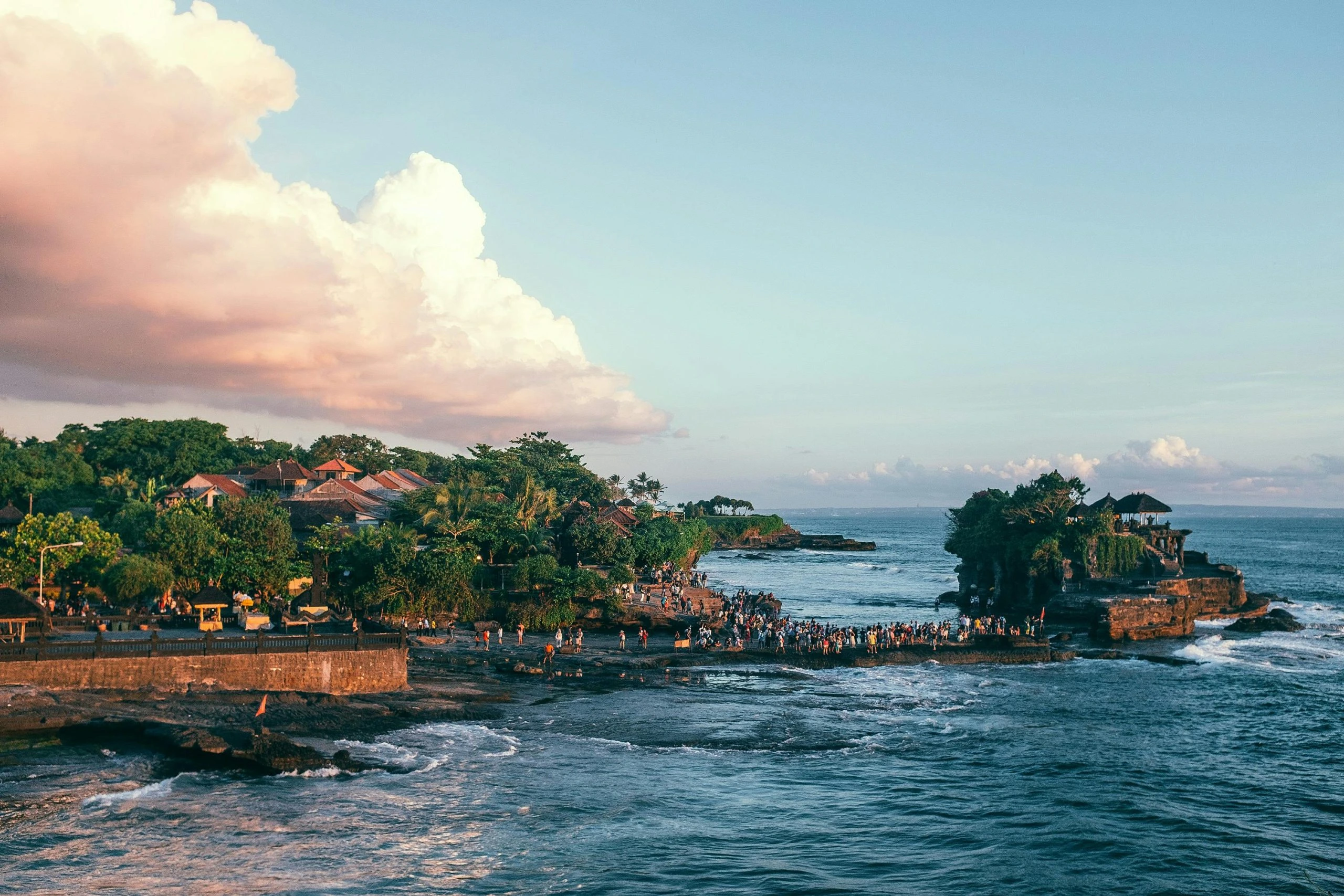
Tanah Lot is a Hindu sea temple built on a rock in the ocean off Bali’s south-west coast, in Beraban village, Tabanan. It is open daily from 06:00 to 19:00, and foreign adults pay IDR 75,000 to enter. Go at low tide if you want to walk across to the base of the rock, and in the late afternoon if you want the famous sunset view.
Tanah Lot is about ten minutes by car from our retreat in Cemagi, so it is the temple we know best and the one our guests visit most often. In this guide we explain the 2026 ticket prices, opening hours, the best time for sunset, how the tides work, what to wear and how to avoid the crowds. For more ideas nearby, see our guide to the best surf spots in Bali along this stretch of coast.
Tanah Lot at a glance
Location
Beraban village, Kediri, Tabanan Regency, south-west Bali
Entrance fee
IDR 75,000 per foreign adult, IDR 40,000 per foreign child
Opening hours
Daily, 06:00 to 19:00
Best time
Late afternoon for sunset, early morning for quiet
Tides
Walk to the base of the rock only at low tide
Time needed
1.5 to 2.5 hours
Dress code
Shoulders and knees covered, sarongs available at the entrance
From Pelan Pelan Bali
About 10 minutes by car
What is Tanah Lot?
Tanah Lot means “land in the sea” in Balinese, and the name describes it well: at high tide the temple appears to float on the ocean. Its full name is Pura Luhur Tanah Lot, and it is one of Bali’s most important sea temples.
History and the priest Nirartha
The temple is credited to Dang Hyang Nirartha, a Hindu priest from Java who travelled through Bali in the 16th century. According to tradition he spent a night on the rock, felt it was a holy place and asked local fishermen to build a shrine to the sea gods. The main deity is Dewa Baruna, also called Bhatara Segara, the god of the sea. Nirartha himself is also worshipped here today.
Tanah Lot is one of a chain of seven sea temples along Bali’s south-west coast. Balinese Hindus believe these temples protect the island from evil forces coming from the sea. Uluwatu temple on the Bukit peninsula, another of Nirartha’s temples, belongs to the same chain.
The sea snake legend
Local legend says that venomous sea snakes live in the caves at the base of the rock and guard the temple against evil spirits and intruders. Black and white banded sea kraits still live along this coast, and you can see one in the small “holy snake” cave opposite the temple.
Restoration of the rock
The ocean has been eroding the rock for centuries. In the 1980s the rock face began to crumble and the area became unsafe. A restoration programme funded by a loan from the Japanese government stabilised the rock and protected the coastline with breakwaters. Large parts of what you see today, reportedly more than a third of the rock, are carefully disguised artificial rock.
Tanah Lot tickets and entrance fees (2026)
Foreign adults pay IDR 75,000 and foreign children IDR 40,000 to enter Tanah Lot. These are the prices listed on the official Tanah Lot website (tanahlot.id).
Visitor
Price
Foreign adult
IDR 75,000
Foreign child
IDR 40,000
Indonesian adult
IDR 30,000
Indonesian child (5 to 10 years)
IDR 20,000
Scooter
IDR 3,000
Car
IDR 5,000
Good to know:
- A price increase was planned for April 2026 but has been postponed. The temple management said it would review prices again later, so check the official site before you go.
- Bring cash or a payment app. Tickets are bought at the counter on arrival.
- The ticket covers the whole area, including the walkways, cliff viewpoints and Batu Bolong temple. The holy snake cave and the holy water blessing ask for a small donation.
- Bali’s tourist levy is separate. All international visitors pay IDR 150,000 once per trip to Bali. It is not charged at Tanah Lot.
- Commercial shoots and drones: photo sessions, filming and drone flights must be reported to the management first.
Tanah Lot opening hours
Tanah Lot is open every day from 06:00 to 19:00. Hours can change on holy days, when the temple is used for ceremonies. The temple on the rock itself is only open to Hindus who come to pray, but visitors can walk the grounds, watch the rituals from a respectful distance and visit the viewpoints at any time during opening hours.
Best time to visit Tanah Lot
The best time to visit Tanah Lot is around 16:00, so you can see the temple in daylight, walk out at low tide if the tide allows and stay for sunset. If you prefer quiet to sunsets, come early in the morning.
Sunset at Tanah Lot
The sun sets behind the temple, which is why Tanah Lot is one of the most photographed places in Bali. In Bali the sun sets between roughly 18:00 and 18:45, depending on the time of year, so check a sunset app on the day.
This is also the busiest time. Late afternoon draws tour buses and the main viewpoints fill up, so arrive at least an hour before sunset. For a better view, walk past the main terrace towards Batu Bolong or the cliff-top cafés, where it is much quieter. Many visitors leave as soon as the sun goes down, so the half hour after sunset is often the nicest.
Early morning
Arriving between 06:00 and 07:00 gives you soft light, cooler temperatures and very few people. You often see locals bringing offerings at this time. It is the best choice if you want photos without crowds.
Dry season or rainy season?
The dry season, from April to October, gives you the best chance of clear skies and a colourful sunset. In the rainy season, from November to March, sunsets are less reliable, but showers rarely last all evening and there are fewer visitors. Read our honest take on Bali’s rainy season if you are travelling then.
Tanah Lot tides: when can you walk to the temple?
You can only walk across to the base of the Tanah Lot rock at low tide. At high tide the rock is cut off by the sea.
- Low tide: a rocky path across the shallows leads to the base of the temple. You can visit the holy spring and receive a blessing, but you cannot climb the stairs into the temple itself unless you come to pray.
- High tide: the path is under water and waves wash around the rock. This is when the temple looks most dramatic from the cliffs.
- Ideal timing: low tide in the afternoon followed by sunset gives you both experiences in one visit.
Check a tide app or tide table for Tanah Lot or nearby Canggu before you go. The rocks are slippery and the waves on this coast are powerful, so stay on the path and turn back if the water starts rising. If you surf with us, you will already know how much the tide changes this coastline; our guide on how tides affect surfing explains why.
What to see at Tanah Lot
The holy spring and water blessing
At the base of the rock a freshwater spring rises from beneath the temple, which is remarkable given that it is surrounded by salt water. Temple priests give visitors a blessing with this holy water, called tirta, sprinkled on your head with a flower and a few grains of rice pressed to your forehead. A donation is expected. If you are interested in water purification rituals, see our article on melukat.
The holy snake cave
In a small cave in the cliff opposite the temple, a sea krait is kept and presented as a holy snake. You can look at it for a small donation. Some stalls also offer photos with snakes and other animals; we skip these, as they are not animal friendly.
Pura Batu Bolong
A short walk north along the cliffs brings you to Pura Batu Bolong, a small temple on a rock arch that the waves wash through. It is quieter than Tanah Lot and one of the best places to watch the sunset with Tanah Lot in the background.
The cliff-top viewpoints
The paved paths along the cliffs give you different angles on the temple. Several cafés on the cliff edge sell cold drinks and young coconuts, which is the most comfortable way to wait for sunset.
Kecak dance
In the evening a Kecak and fire dance is performed in the cultural park at Tanah Lot, usually from about 17:30. Kecak is a hypnotic chant-based dance that tells a story from the Ramayana. Tickets are sold separately.
The market
The walk from the car park to the temple leads through a large market with souvenirs, sarongs, art and snacks. Try pisang goreng (fried banana) or a cold coconut.
What to wear and how to behave
Wear clothes that cover your shoulders and knees, as Tanah Lot is an active Hindu temple. Light trousers, a long skirt or a sarong work well. Sarongs can be rented or bought at the entrance. Swimwear and very short shorts are not appropriate.
Etiquette tips:
- Wear shoes with grip. The rocks at low tide and the cliff paths are uneven and slippery after rain.
- Do not climb the rocks or temple walls, and do not enter areas closed to visitors.
- Give way to people praying and do not walk in front of them or step over offerings. Our article on offerings in daily Balinese life explains their meaning.
- Ask before photographing people during a ceremony.
- Drones need permission from the management.
Ceremonies and festivals at Tanah Lot
The temple anniversary, called piodalan or odalan, is held every 210 days on Buda Wage Langkir in the Balinese pawukon calendar. On these days thousands of Balinese Hindus come to pray, dressed in white and carrying offerings. In 2026 it fell on 1 July, which makes the next piodalan around 27 January 2027. It is a beautiful time to visit, but expect crowds and parts of the area to be reserved for worshippers.
Tanah Lot also hosts the Tanah Lot Art and Food Festival each August, with dance, music and local food. In 2026 it was held from 21 to 23 August.
No visits are possible on Nyepi, Bali’s Day of Silence, when the whole island shuts down. Read more in our guide to Nyepi.
How to get to Tanah Lot
There is no public transport to Tanah Lot, so most visitors come by private driver, taxi app, scooter or on a tour. The roads near the temple are narrow and get busy before sunset.
From
Approximate travel time
Pelan Pelan Bali (Cemagi)
10 minutes
Canggu
20 to 30 minutes
Seminyak
45 to 60 minutes
Sanur
About 50 minutes
Uluwatu
About 1 hour or more
Ubud
1 to 1.5 hours
Travel times depend heavily on traffic. From the car park it is a 10 to 15 minute walk through the market to the temple.
If you are staying in Canggu, Seminyak or Ubud, a visit to Tanah Lot is usually a half-day trip. Staying nearby makes it far easier to time your visit with the tide and the sunset.
What to combine with Tanah Lot
Tanah Lot sits on one of the quietest stretches of Bali’s south-west coast. You can easily combine it with:
- Pekendungan Beach: a black sand beach just north-west of the temple, with empty bays and rice fields behind it.
- Kedungu and Yeh Gangga: surf beaches and fishing villages further up the coast. Both feature in our guide to uncrowded surf spots in Bali.
- Cemagi, Seseh and Pererenan beaches: quiet black sand beaches south of Tanah Lot with beach cafés for sunset.
- Taman Ayun temple: a royal temple with moats and gardens in Mengwi, around 30 minutes inland.
Visiting Tanah Lot from Pelan Pelan Bali
Our retreat is in Cemagi, about ten minutes from Tanah Lot. That means you can visit at the moment that suits you: early in the morning before your surf lesson, or after afternoon yoga for sunset, without sitting in traffic. Tanah Lot is one of the trips we organise for guests.
Want to stay close to Tanah Lot? Have a look at our rooms and suites in Cemagi, ten minutes from the temple and a short walk from the beach.
Practical tips for visiting Tanah Lot
- Check the tide before you leave if you want to walk to the base of the rock.
- Arrive an hour before sunset, or go early in the morning to avoid the crowds.
- Bring cash for tickets, donations, parking and snacks.
- Wear sun protection and bring water. There is little shade on the walkways.
- Wear sturdy sandals or trainers, especially in the rainy season.
- Pack a sarong, or rent one at the entrance.
- Protect your camera from sea spray at high tide.
- Do not swim. The currents and waves around Tanah Lot are dangerous.
Frequently asked questions
Is Tanah Lot worth visiting?
Yes. Tanah Lot is one of Bali’s most important sea temples and one of the island’s most beautiful sunset spots. It is busy, especially before sunset, but you can avoid most crowds by coming early in the morning or walking to the quieter viewpoints near Batu Bolong. Time your visit with low tide to see the holy spring at the base of the rock.
Can you go inside Tanah Lot temple?
No, not as a tourist. The temple on the rock is reserved for Hindus who come to pray. At low tide you can walk to the base of the rock, visit the holy spring and receive a water blessing from the priests. The rest of the area, including Batu Bolong and the cliff paths, is open to all visitors.
How much is the entrance fee for Tanah Lot?
The entrance fee for foreign visitors is IDR 75,000 per adult and IDR 40,000 per child, according to the official Tanah Lot website. Indonesian visitors pay less. Parking costs IDR 3,000 for a scooter and IDR 5,000 for a car. A price increase planned for 2026 has been postponed, so check the official site before your visit.
What time is sunset at Tanah Lot?
Sunset in Bali is between roughly 18:00 and 18:45, depending on the season. Arrive around 16:00 to 17:00 to find a good spot and, if the tide is low, to walk to the base of the temple first. The dry season from April to October gives you the best chance of a clear, colourful sunset.
Why shouldn't couples visit Tanah Lot together?
According to a local myth, unmarried couples who visit Tanah Lot together will break up. It is a popular story rather than an official rule, and many couples visit every day. There is no religious ban on couples visiting.
How long do you need at Tanah Lot?
Plan 1.5 to 2.5 hours. That gives you time to walk through the market, visit the temple and the holy spring, walk to Batu Bolong and watch the sunset. Add another hour if you want to see the Kecak dance or have dinner at one of the cliff-top restaurants.
Planning your visit to Tanah Lot
Tanah Lot is at its best when you time it well: low tide for the holy spring, late afternoon for the sunset and quiet viewpoints away from the main terrace. Dress respectfully, bring cash and allow time to walk along the cliffs to Batu Bolong.
If you would like to stay close to Tanah Lot and combine your visit with surfing and yoga, take a look at our surf and yoga retreat packages.